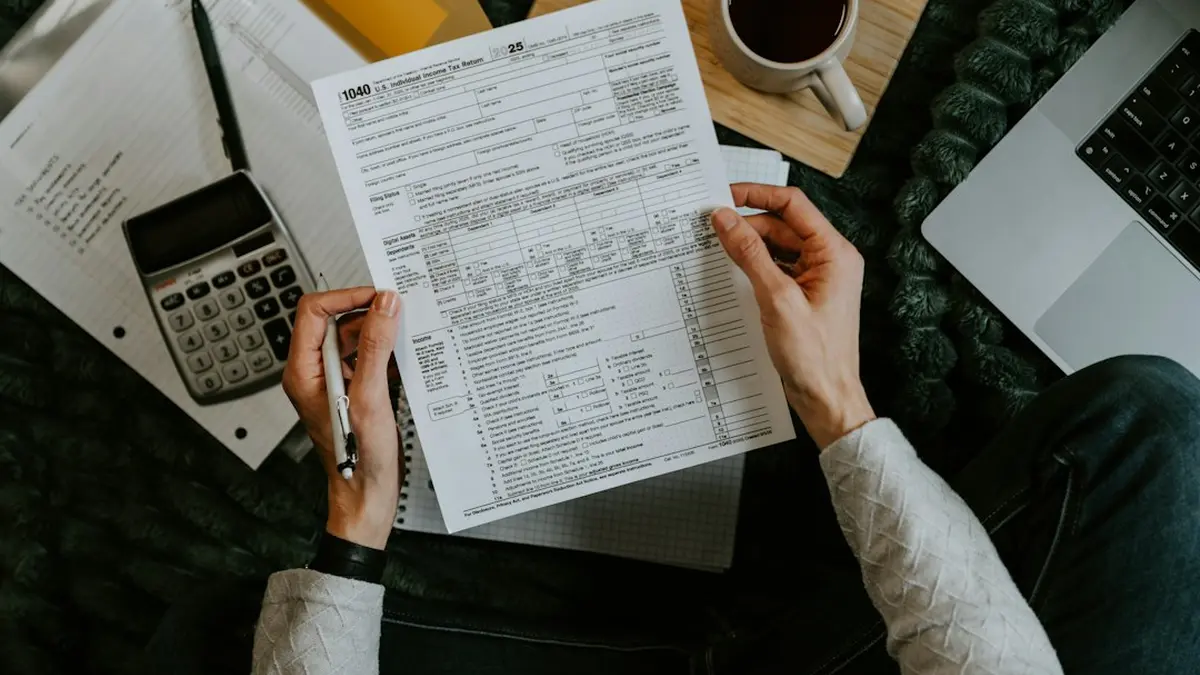
If you freelance, drive for an app, take 1099 work or own a small business, a lender will qualify you on the net income on your tax returns, usually averaged over two years, and not on what you bill. Every write-off that cut your tax bill also cuts the amount you can borrow. This page shows you how to work out that number yourself before a lender does, which documents change because you're self-employed, and what to do if the figure comes up short.
Lenders count profit, not billings
Qualifying income is the monthly figure a lender uses to decide how large a mortgage payment you can carry. For a salaried buyer it comes off a pay stub. For you it comes from your tax returns, after business expenses.
"Your taxable income is what counts, not your gross receipts," is how Jason Nichols of Truss Financial Group puts it. Better's guide for self-employed borrowers gives the standard formula: add up your net Schedule C income for the last two years and divide by 24 months. Its example is a borrower who grosses $150,000 and deducts $55,000 in business expenses. That borrower qualifies on $95,000, not $150,000.
One adjustment works in your favor. Lenders add back certain non-cash deductions, which are expenses on your return that didn't take money out of your account, such as depreciation. Fannie Mae, whose Selling Guide sets the rules most conventional lenders follow, requires the lender to run a written cash-flow analysis (its Form 1084 or its automated Income Calculator) rather than use gross revenue.
The cost of heavy deductions is large. The Mortgage Reports calculates that losing $2,000 a month in deductible income can cut a buyer's home budget by more than $150,000.
Before you apply
The general pre-approval paperwork (ID, pay records, asset statements, debts) is the same for everyone and is covered in how pre-approval works. What changes for you depends on how your business is set up. Fannie Mae's self-employed documentation rules ask for two years of signed federal returns with every schedule attached, or IRS transcripts for the same two years, plus the business returns that match your structure:
-
Sole proprietor, freelancer or 1099 contractor
Two years of personal returns (Form 1040) with Schedule C, plus your 1099s.
-
Partnership or multi-member LLC
Form 1065 business returns and your Schedule K-1.
-
S corporation
Form 1120-S business returns and your Schedule K-1, plus W-2s if you pay yourself a salary.
-
C corporation
Form 1120 business returns.
-
A year-to-date profit and loss statement
Shows the lender what the current year looks like. Chase, JVM Lending and Better all list it.
-
Recent business bank statements
Chase, JVM Lending and Better each ask for two months. The Mortgage Reports says some lenders want 12 to 24 months. How many you need varies by lender.
-
Proof the business is active
A business license, a CPA letter, articles of organization or a partnership agreement.
Three rules decide whether you need all of that:
- The 25% line. Fannie Mae applies full self-employed rules once you own 25% or more of the business. If you own less than 25% of a partnership or S corp, simpler K-1 rules apply: two years of personal returns and K-1s, and proof you actually received distributions at the level being counted.
- One year of returns instead of two. Fannie Mae allows this if the business has existed for five years, you've held at least 25% of it continuously for those five years, and the lender completes a cash-flow analysis. Your lender decides whether to use it.
- One year of self-employment. Fannie Mae can accept 12 months of self-employment income on your latest return if you previously earned W-2 income in the same line of work at a level equal to or greater than what you now earn on your own.
The sources don't give costs for gathering these documents. If a CPA letter or a prepared P&L will cost you money, ask your accountant for a price before you start. Timing matters more than cost: Fannie Mae generally wants credit documents to be less than four months old at closing.
If part of your income is rent, Fannie Mae announced new rental income rules on September 2, 2026, including more conservative treatment of short-term rentals. They apply to loan applications dated on or after November 1, 2026.
Work out the number a lender will use
The first real result is a monthly qualifying income figure you calculated yourself and can check against the lender's. It takes an evening with your last two returns. It is an estimate: the lender's analysis will differ in the details.
-
1. Find net profit for each of the last two years
For a sole proprietor it's the net profit on Schedule C. For a K-1 it's your share of the business income. You should end up with two figures, one per year, after expenses.
-
2. Add back depreciation
Find any depreciation or amortization you claimed and add it to that year's figure. Lenders treat these as non-cash. Exactly what gets added back is set by the lender's analysis, so treat this as an upper estimate.
-
3. Compare the two years
If the second year is equal to or higher than the first, add them together. If it's lower, Truss Financial Group and Better both describe lenders using only the lower, most recent year instead of averaging. Use the lower year so the estimate doesn't flatter you.
-
4. Divide by months
Two years added together: divide by 24. One lower year: divide by 12. Using Better's example, $95,000 of net income in each of two years comes to about $7,917 a month.
-
5. Add W-2 wages separately
If you also have a salaried job, add that monthly pay on top. Fannie Mae requires each income source to meet its own documentation rules, so the two are checked separately.
-
6. Test it against a debt-to-income limit
Debt-to-income (DTI) is your total monthly debt payments, including the new mortgage, divided by your monthly income. Chase says most conventional approvals want it below 43%; Better says self-employed buyers are best placed at 36% or below. At $7,917 a month, 43% is about $3,404 for all debts combined. Subtract your current car, card and student loan payments. What's left is roughly the most your mortgage payment can be.
-
7. Write a year-to-date profit and loss statement
Income and expenses from January 1 to now. If this year is running below last year, write a short explanation now. Truss Financial Group notes that a significant decline calls for a written explanation plus a current P&L.
-
8. Apply for pre-approval and ask for the lender's income figure
It worked when the lender tells you the monthly income it is using. If it's far below yours, ask which deductions or which year caused the gap.
If your figure in step 6 leaves little or no room for a mortgage payment, that isn't a verdict on whether you can afford a home. It tells you your returns don't show enough income on paper. The last section below covers what to do about that.
Four ways self-employed files stall
Maximizing deductions the year before you buy. You'll know this has happened if your step 4 figure is well below what you actually take home. The write-offs are already filed, so you have two options: wait for a year with fewer deductions to appear on a return, or look at the bank-statement route below. Talk to your tax preparer before filing the next return, not after.
Changing your business structure right before applying. Better warns that moving from sole proprietor to an LLC or S corp before you apply can reset the two-year self-employment clock. If you're considering a switch, ask a lender whether it would restart your history before you file the paperwork.
Handing over an incomplete or messy file. Lower, a digital mortgage lender, lists the usual causes of delay for self-employed applicants: "missing pages, inconsistent deposits, outdated business records and unexplained income changes." You'll see it as a stream of follow-up requests after you apply. Send every page of every return, including blank schedules, and have a one-line explanation ready for any large or unusual deposit.
Running business and personal money through one account. Bankrate recommends keeping a separate business checking account. When the two are mixed, it's harder for an underwriter to tell which deposits are business income. If yours are combined, open a separate account now: the sooner you start, the more months of clean statements you'll have by the time you apply.
If the number comes up short
Once you have your own income figure, you know which kind of loan you're shopping for.
If your returns support the payment you want, you're choosing between standard loan types. Bankrate puts conventional loans for self-employed borrowers at as little as 3% down with a 620 credit score, and FHA at 3.5% down with a 580 score. The exact conventional loan requirements and the FHA credit and income bar are on their own pages. Self-employed VA borrowers who qualify as veterans or service members can use that program too.
If your returns don't support it, there are two paths. The first is to wait for another year of returns that show more income. That costs time but keeps you on standard pricing. The second is a non-QM bank-statement loan, which qualifies you on 12 to 24 months of bank deposits instead of tax returns, so your deductions don't reduce the income the lender counts.
The costs are real. Better says bank-statement loans come with higher rates and larger down payments, typically 10% to 20%. JVM Lending puts the credit floor for these loans at around 660, above the conventional minimum. The sources don't give a current rate gap, so compare actual quotes. There is also a catch: Better notes that giving your tax returns to a bank-statement lender can make you ineligible for that program's income method, so decide which route you're on before you send documents.
A bank-statement loan is the wrong choice if waiting one more year would get you a standard loan, or if 10% down would use up your emergency savings. It suits you if your deposits are steady, your returns will stay low for legitimate tax reasons, and you have the larger down payment ready.
The next step on either path is to put your income figure and credit range into the calculator and see which rates you qualify for. That's also how you ask to be matched with lenders who work with self-employed buyers.
Comments
No comments yet. Be the first to comment!
Leave a Comment